






Articles
07.21.26
By: Anthony Murphy
Modernizing Jury Engagement Starts With Better Communication
Improving juror attendance starts with communication that is clear, accessible, and aligned with how people engage today.

Every court administrator knows the challenge of juror no-shows. Empty seats mean smaller jury pools, last-minute efforts to summon replacement jurors, and greater pressure on trial schedules. In some jurisdictions, delays ripple through the justice system, affecting judges, attorneys, defendants, victims, and witnesses. At its core, reducing no-shows comes down to one idea worth keeping in view throughout: make it easier for people to fulfill their civic responsibility, not harder.
For decades, a common response has been to summon more jurors. If experience suggests a significant percentage won’t appear, then it’s logical to increase the size of the initial pool. Although it’s a practical solution, it addresses the symptom rather than the cause.
This approach assumes that most no-shows stem from compliance issues: jurors received their summonses, understood what was being asked, and simply chose not to respond. Yet for many community members, the obstacle isn’t an unwillingness to serve. It’s a jury process that hasn’t kept pace with how people expect to receive and act on important information.
Rethinking the No-Show Response
Treating no-shows as a numbers problem creates an endless cycle. More summonses generate more administrative work, more follow-up, more failure-to-appear notices, and more outreach—all without addressing why participation broke down in the first place.
The costs extend well beyond operational efficiency. Court staff spend valuable time managing administrative tasks that pull them away from other priorities. Jury pools may become less representative when participation depends heavily on stable mailing addresses, flexible work schedules, or familiarity with court processes. Beyond that, every confusing interaction shapes how the public perceives the justice system itself.
Reducing no-shows starts with understanding why jurors didn’t engage in the first place, not how to replace them.
Four Common Communication Gaps
Juror no-shows are rarely the result of a single issue. More often, they are the outcome of several communication challenges occurring throughout the process.
- The summons never reaches the juror. Address information that is drawn from voter registrations, DMV records, or other public databases can quickly become outdated, especially in communities with high residential turnover. In some jurisdictions, a meaningful share of mailed summonses is returned as undeliverable, meaning a portion of what looks like a no-show problem is really an address one the court might not catch until the reporting date has already passed.
- The instructions are not clear. Jury summonses are legal documents, often written in dense, formal language with little plain-language guidance. Questions about reporting requirements, postponements, hardship exemptions, and next steps can create enough uncertainty that people delay responding, if they even respond at all.
- The process creates unnecessary barriers. Requesting a deferral, asking a question, or claiming a hardship exemption has traditionally required paperwork, an in-person visit, or a phone call placed during business hours. This means jurors without reliable transportation, flexible schedules, or accessible options may find even a simple request disproportionately difficult to complete.
- Courts rely on communication channels people use less often. First-class mail remains an essential part of jury administration, but it no longer reflects how most people expect to receive timely information. Individuals increasingly rely on text messages, email, and online services for important updates, while paper mail may receive less immediate attention.
Viewed together, these point to communication and process-design challenges, not compliance ones. None of them call for more enforcement; they call for better design.
How Leading Courts Are Responding
Courts modernizing their jury operations are increasingly focused on reducing barriers rather than increasing enforcement.
Many are supplementing mailed summonses with automated text messages or emails that confirm receipt, remind jurors of upcoming reporting dates, and provide timely updates. Rather than replacing the official summons, these reminders reinforce it, helping ensure important information is seen before a missed appearance occurs.
Self-service portals have become another important tool. Rather than requiring jurors to call the courthouse, online services allow them to confirm attendance, request a postponement, complete questionnaires, or submit hardship requests at their convenience. That flexibility benefits both jurors and court staff by reducing phone volume and eliminating routine administrative work.
Some courts are also implementing automated outreach workflows that identify missed deadlines early. Instead of immediately escalating to a formal failure-to-appear process, courts can provide additional reminders or clarification to quickly resolve any confusion.
The common thread is simple: make it easier for people to fulfill their civic responsibility instead of making them work harder to navigate the process.
Better Communication Benefits Everyone
Improving juror engagement isn’t simply about reducing no-show rates.
Clearer communication and more convenient service reduce administrative workload, help courts make better use of staff resources, and support more predictable jury operations. They also contribute to more representative jury pools by removing barriers that disproportionately affect younger residents, renters, shift workers, and others whose circumstances may make traditional communication methods less effective. Just as importantly, these same changes reshape how the public experiences the justice system as a whole.
For many, jury service is the most direct interaction they have with the courts. A straightforward process, timely reminders, and accessible self-service options create an experience that feels organized, responsive, and respectful of community members’ time. Those seemingly small interactions shape public confidence in government institutions, often more than people expect.
Juror no-shows can be a signal that communication methods haven’t kept pace with the people courts are trying to serve. By shifting the conversation from compliance to communication, courts can improve participation and create a jury experience that better serves both the justice system and the communities it represents.
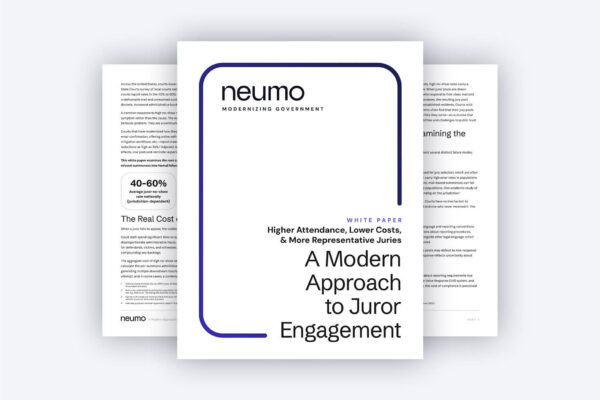
Higher Attendance, Lower Costs, & More Representative Juries: A Modern Approach to Juror Engagement
Download the white paper for a closer look at the full juror engagement lifecycle, including delinquency mitigation strategies, ADA and language access considerations, and approaches to building a modernization business case.